Two years ago, Gwolves turned the mouse world on its head with the HSK and HSK Pro — tiny, featherlight powerhouses that redefined how we think about fingertip control and micro-aiming. They didn’t just make a splash; they shifted the entire landscape for competitive gamers chasing precision. Now, Gwolves is back with the Fenrir Max and Fenrir Asym. They’re similar but different — cut from the same cloth yet clearly crafted for distinct types of aimers. Is this the start of a new wave where mice become even more specialized for how we play? Let’s dig in and see what’s going on here.
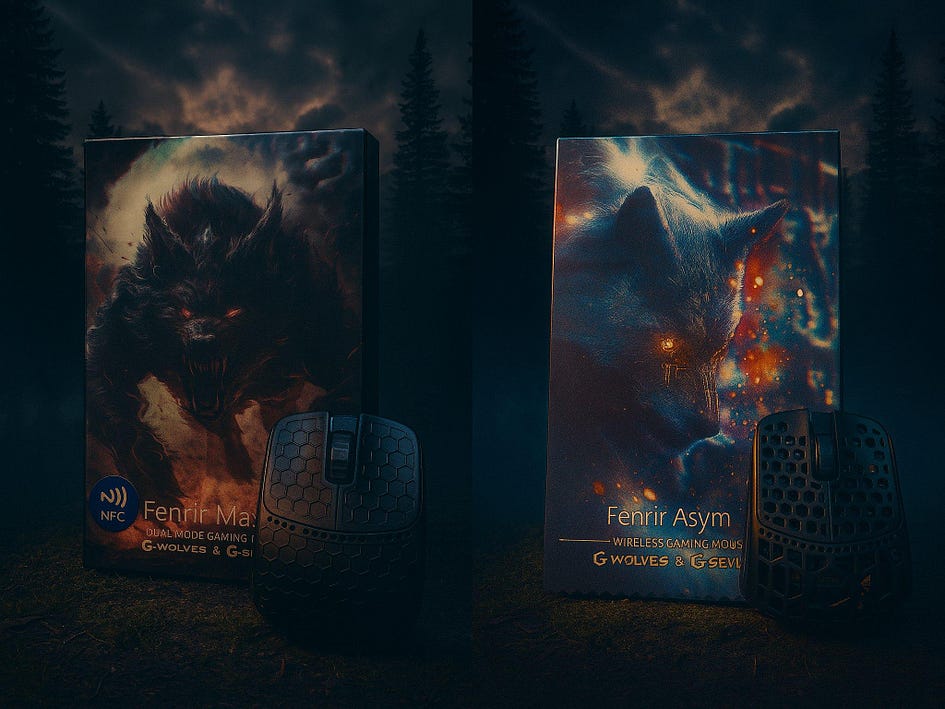
Disclaimer: This unit was provided to me for testing purposes, though Gwolves had no sway over the contents of this review.
Scenarios
Testing time: 4 weeks
Hand size: 21 x 12 cm
Grip: hybrid relaxed claw/finger
Humidity: 55–60%
Skates: stock dots skates, full stock skates.
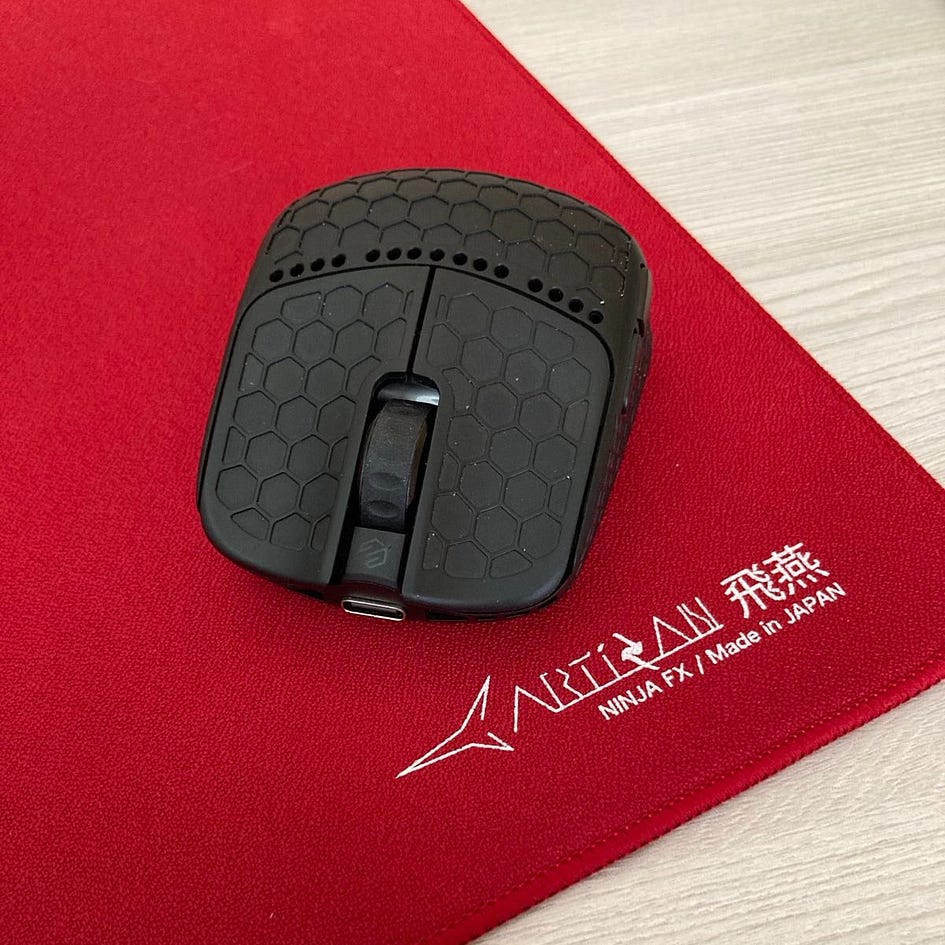
Mousepads: Artisan Hien Soft, OwePowe Summer Camp, Kin X, Matrova Breeze, Waizowl Falcon.
Games: Battlefield 1, Battlefield V, QuakeWorld, Doom Eternal.
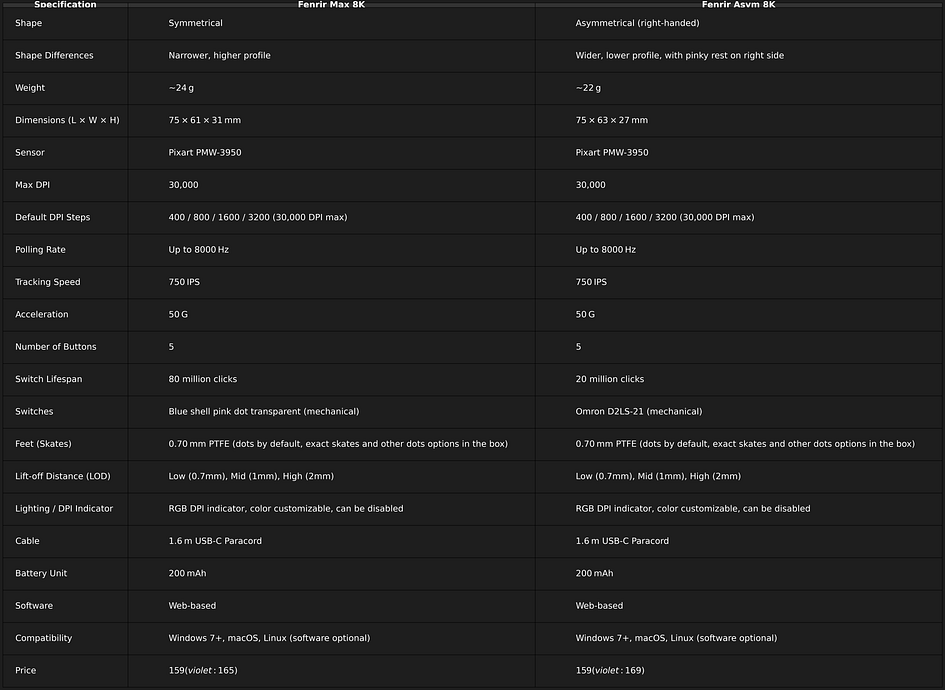
The Differences
In the box
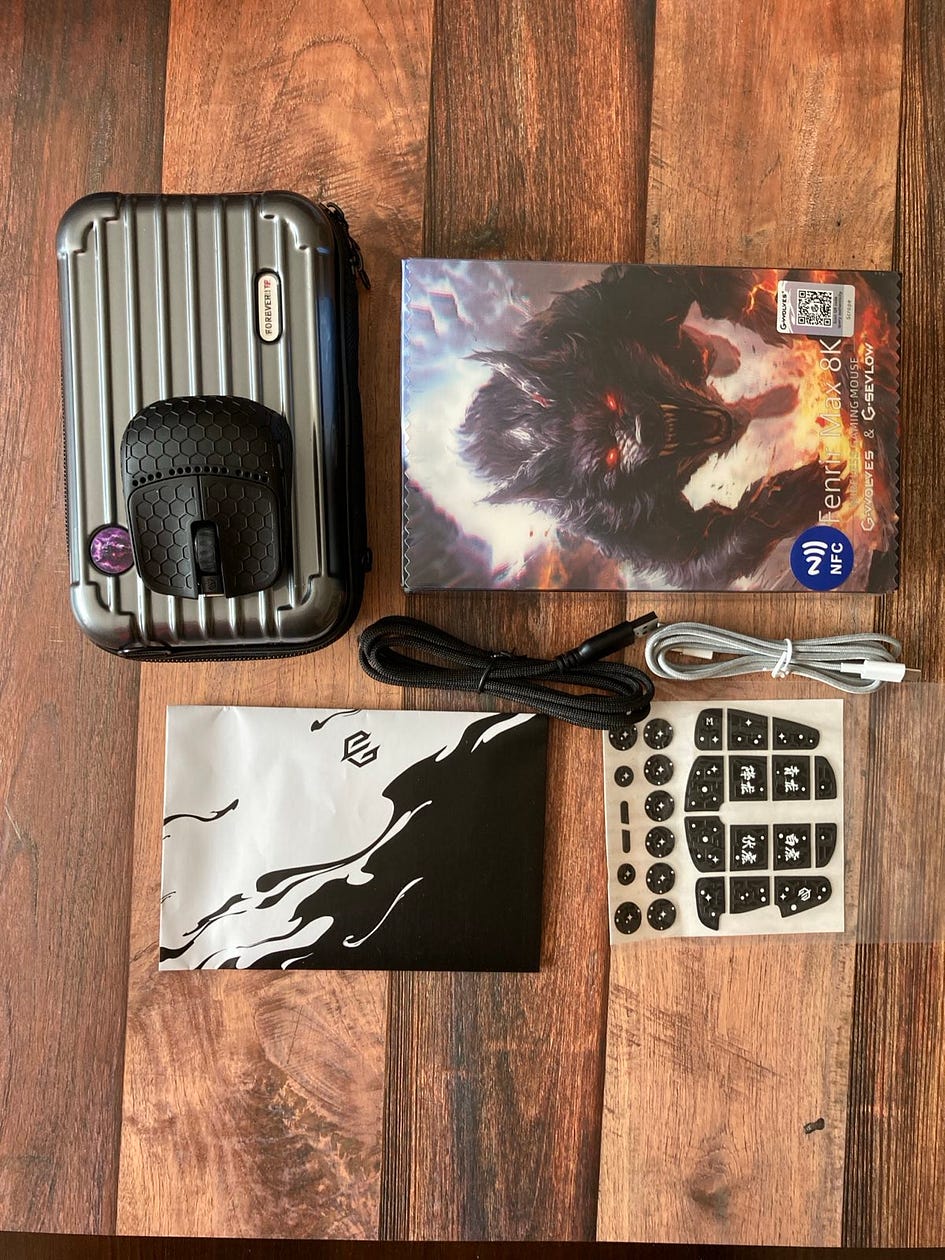
The only difference between the two boxes is the mouse:
- Fenrir Max or Asym 8k
And the rest is the same:
- USB-C to A data cable
- 8k dongle
- G-wolves 3d card
- USB-C to A braided cable
- carrying pouch
- two different leashes (long and short one)
- different skates, also lots of dots
- carrying case
- manual
- grip tapes
- stickers to secure the bottom of the mouse
- molding clays
- gaming sleeve
Bottom line? Amazing unboxing and contents in the box, the best in the industry. Absolute top premium impression and customer care, as usual.
Unboxing and First Impressions (click!)
Shape and Design
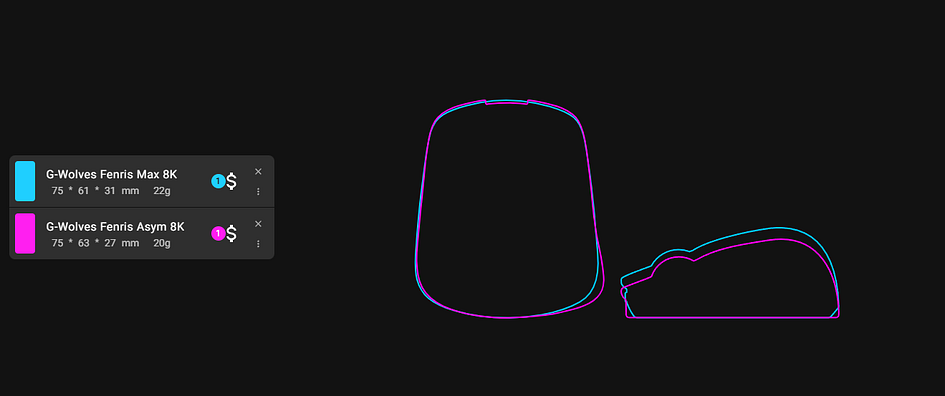
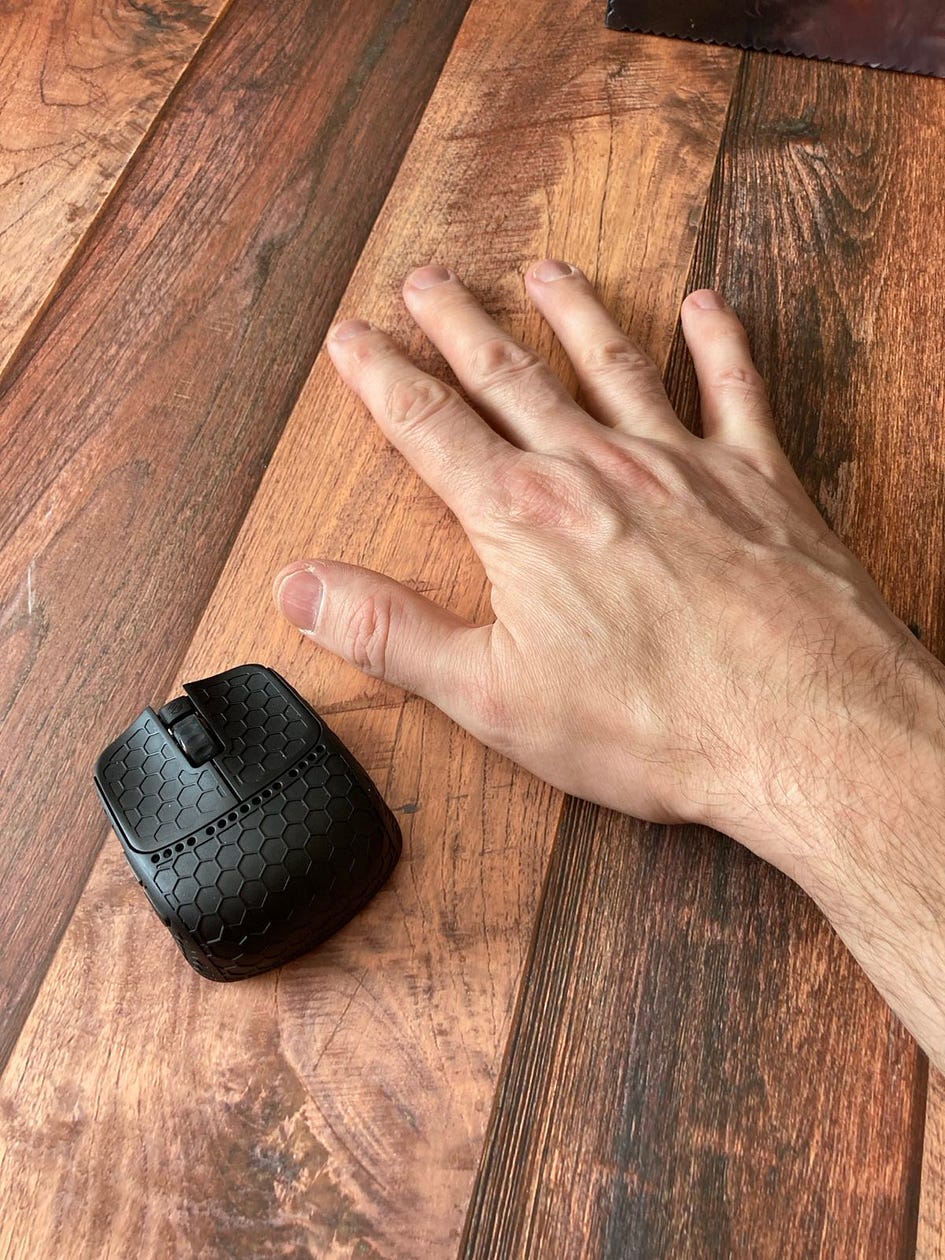
This is basically the classic fingertip mouse — that small “matchbox” shape like the original HSK, just scaled up. It’s designed more for a pinch grip, with the right front edge giving your ring and pinky fingers a place to rest. That little shelf helps a lot with grip stability, something many HSK users had asked for.
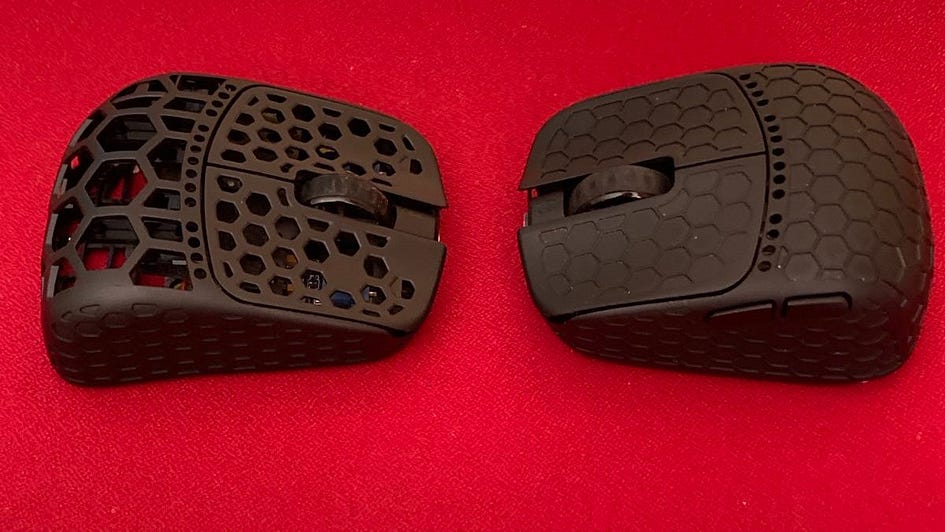
Right off the bat, you can see the first key difference: the Max has a flat right side, while the Asym curves out to support your pinky. On the left, where your thumb sits, both mice get it right. The contour gives your thumb a bit of freedom to move, especially when going for the side buttons. In this area, the flatter sides keep things feeling stable and locked in.
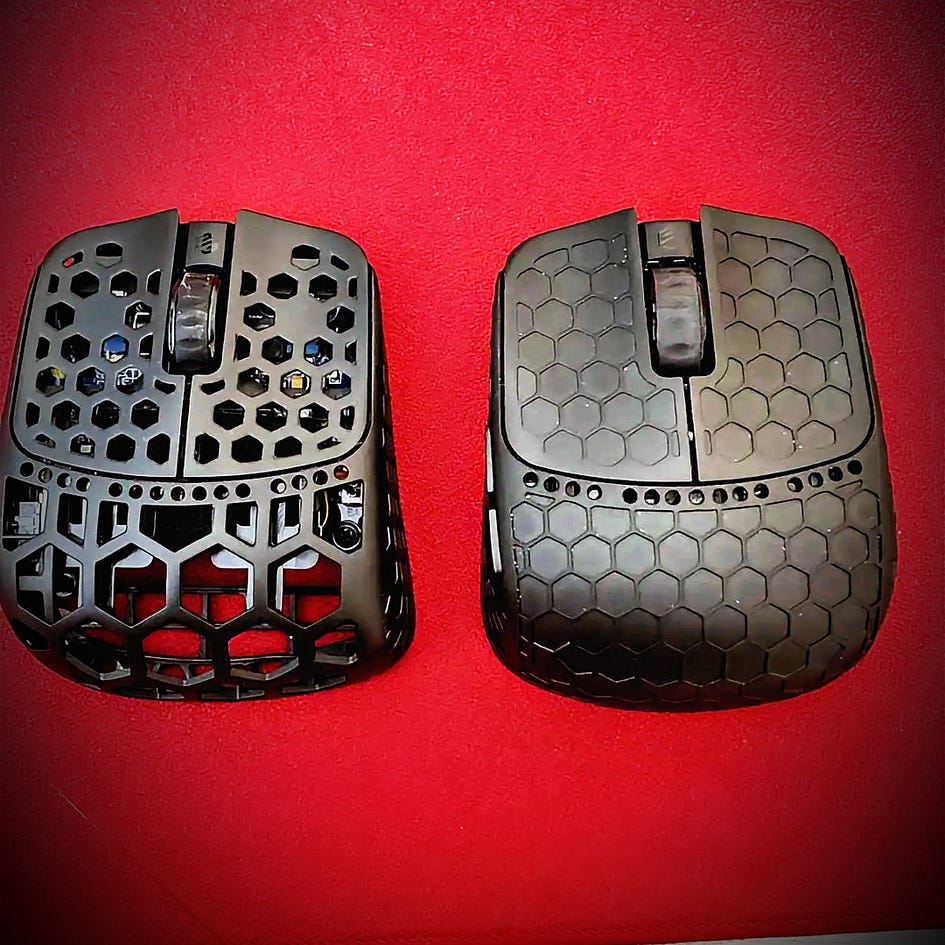
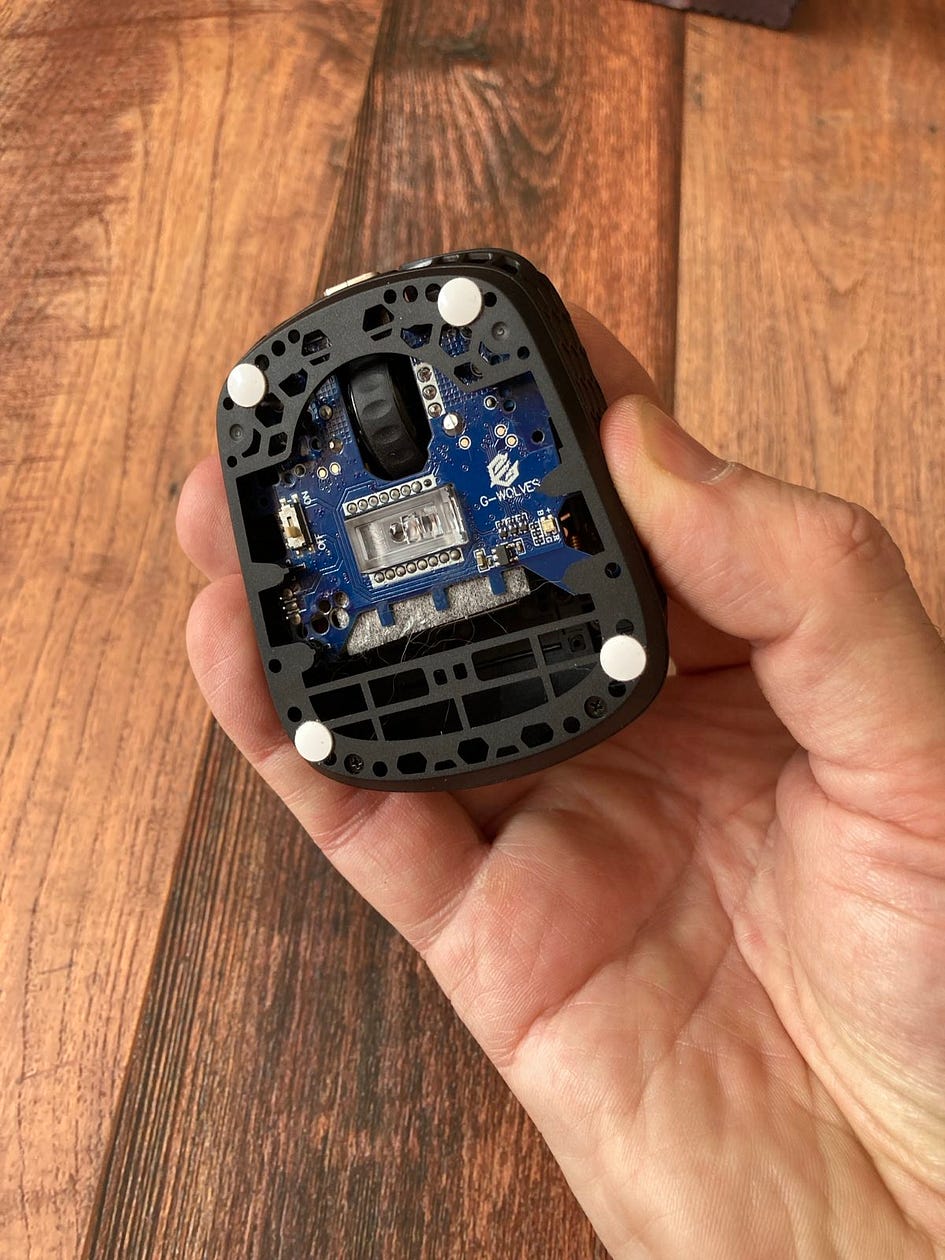
I do still wish G-Wolves had thrown in a DPI button. I like to change DPI when I switch games, and now I have to keep their web app open just for that — kind of a hassle. They did add a tiny on/off switch on the bottom, which is very G-Wolves.
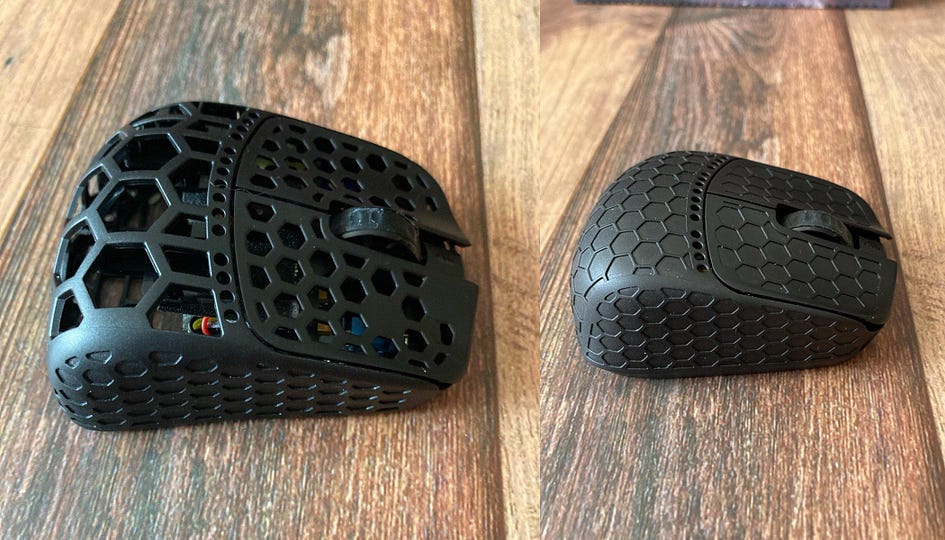
As for looks, I’m not really into the honeycomb cutouts on the Asym. I’d have preferred the smooth, clean surface like on the Max. But I get why they did it — it cuts down weight. Still, that golf ball-like texture on the Max is pretty cool and adds some nice character.
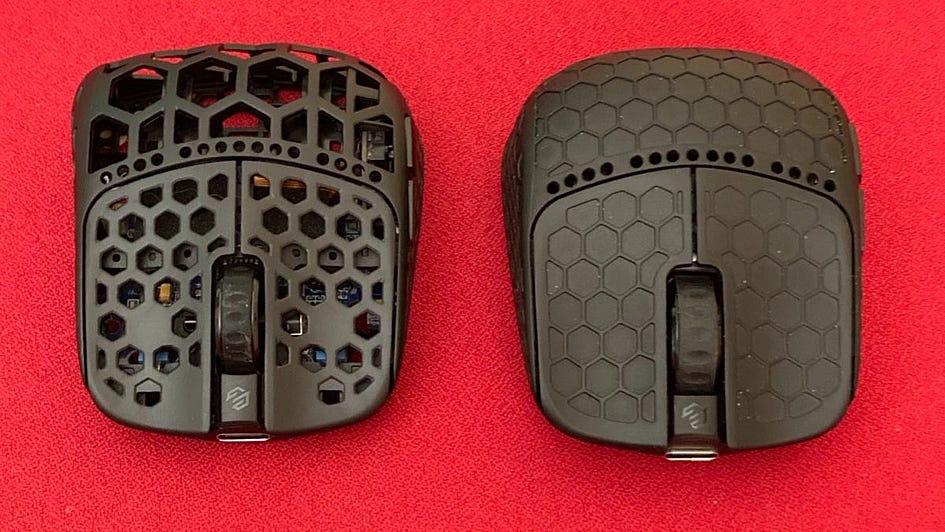
So, difference number two: Max looks like a golf ball, and Asym goes for a honeycomb. Then there’s the third difference — the click height. The Asym’s buttons sit much lower, which means your fingers get closer to the mousepad. You notice it during gameplay. Lastly, the Asym is a bit wider, sits lower, and is slightly lighter than the Max, and also, their scroll wheels are a bit different.
Overall, Asym and Max might look related, but they each have their feel — and that’s a good thing. It gives people real options depending on what shape and handling they prefer.
Bottom line? Similar, but different.
Coating and Weight
The Max has this perforated coating that looks a bit like a golf ball, and it helps add some extra grip. Honestly, if G-Wolves hadn’t used it, I think the experience would be completely different. The coating itself isn’t perfect — without that texture, the mouse might just slip right out of your hand. With such a tiny mouse, having the right surface matters.
The same idea applies to the Asym, though instead of dimples, it’s got holes all over. For some people, that might improve grip. Either way, G-Wolves includes grip tape in the box, which is one of their signature touches — and it’s genuinely useful.
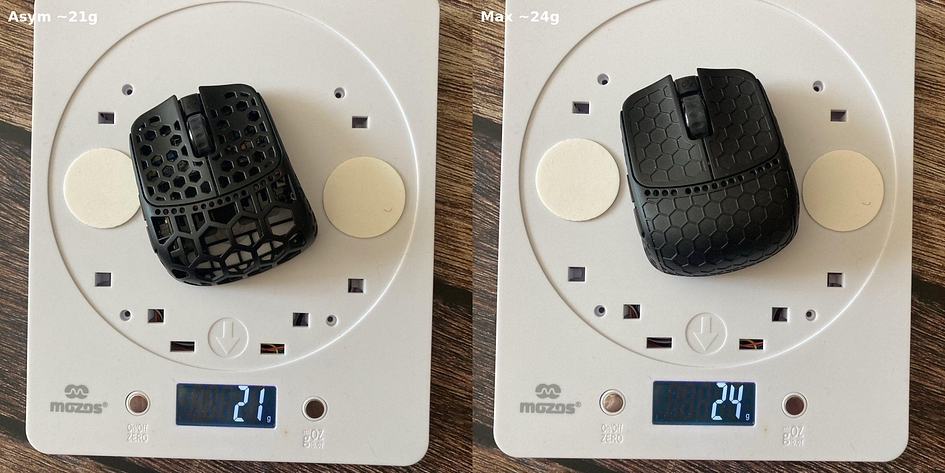
As for weight, these mice are tiny, so of course they can’t be heavy. G-Wolves nailed it: the Asym comes in at about 21 grams (but closer to 22 grams), and the Max is around 24 grams, depending on which skates you use. Both feel incredibly light and balanced, almost like there’s nothing there at all.
Because of that, I wouldn’t pick these for slower, more tactical shooters. But to be fair, I know some high-level Valorant players who’d completely disagree. It all comes down to preference.
Bottom line? I’d love to have an improved coating. The weight is spot on.
Build Quality
I remember when G-Wolves first hit the scene, they had a bit of a reputation for spotty quality control. Some of their earlier mice felt rough around the edges, mostly because they were trying to break new ground with weight reduction and unconventional designs. It was a trade-off: you got an insanely light mouse, but sometimes at the cost of build consistency.
But looking at them now, that’s changed. Those days seem long behind them. When you pick up one of these new Fenrir models and start pressing around — whether it’s the top shell, the buttons, or the honeycomb sides — there’s zero creaking, no flexing, no odd noises. Everything feels tight and secure.
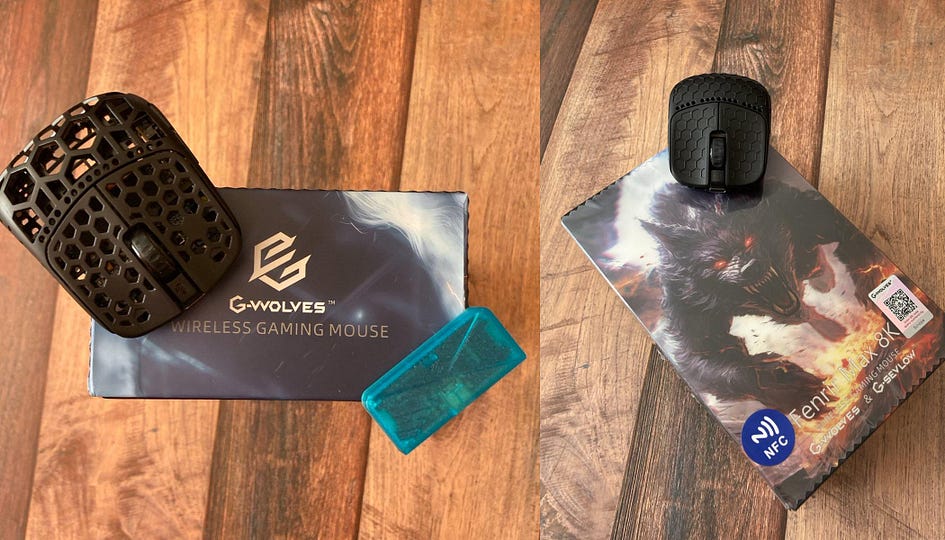
What’s even more impressive is how solid these mice feel despite barely tipping the scale. Mine read just over 20 grams, which is absurdly light, yet at no point does it feel like it’s fragile or ready to crack. It’s the opposite. They’ve pulled off something pretty rare: a super lightweight build that still feels rock-solid. No rattles, no wobbly buttons, nothing loose.
Honestly, with each new release, it seems like G-Wolves is closing the gap toward true premium quality. You’d never guess from the weight that these are as tough and well put together as they are. It’s proof that they’ve dialed in their manufacturing — and that old reputation is starting to look pretty outdated.
Bottom line? G-Wolves keeps releasing better and better-built mice these days.
Clicks, Buttons, and Skates
The main mechanical switches on both of the mice have a sharp, satisfying click with just the right amount of travel before and after actuation. They snap back quickly, which makes spamming clicks both easy and comfortable. In-game, they’ve been flawless for me. I also like the slight inward curve on the buttons — it helps your fingers naturally settle into place. There is a tiny bit of side-to-side wiggle if you try to move them, but it’s so minor you don’t feel it during actual use.
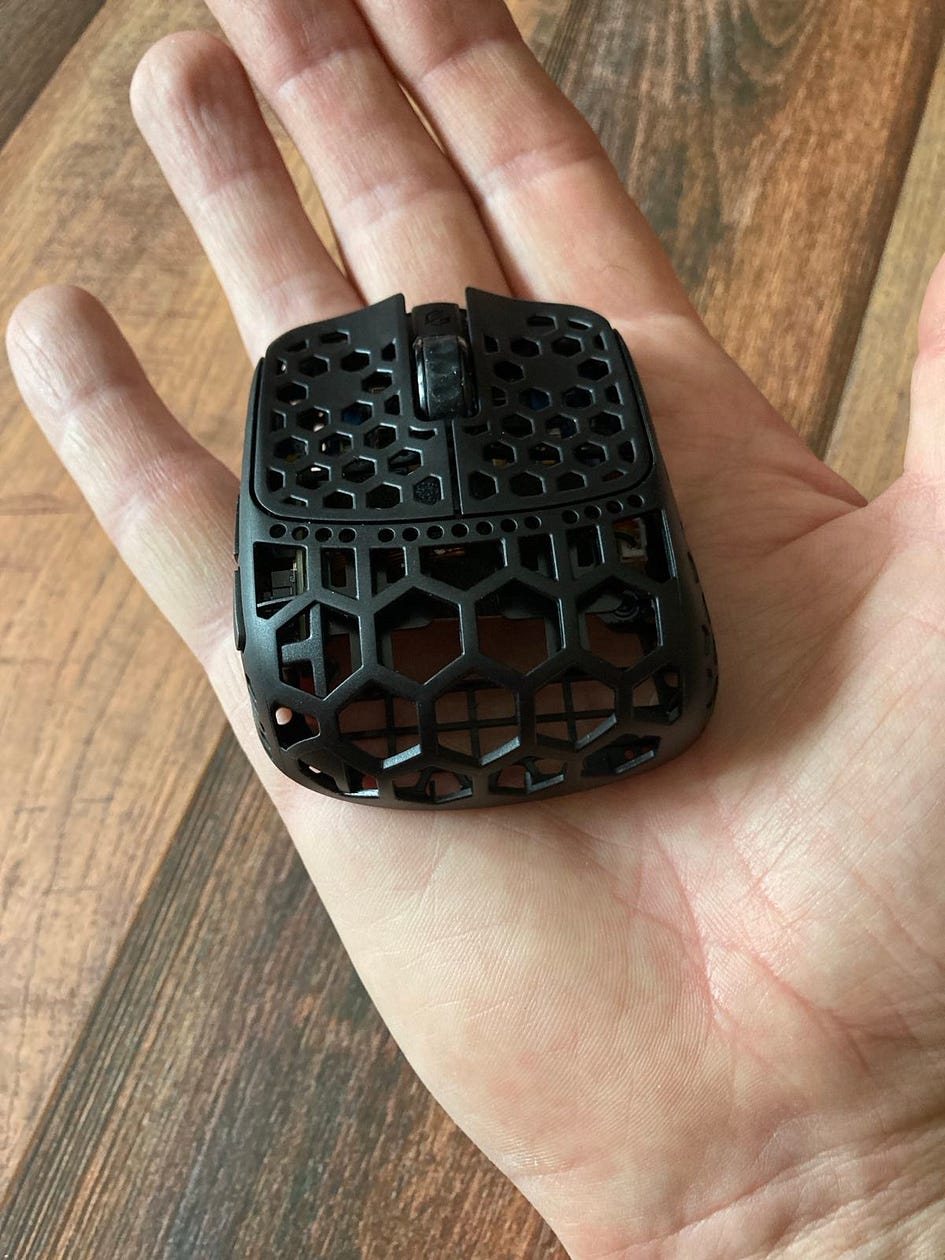
One thing to point out: the Asym’s clicks are noticeably lighter than the Max’s, and since they’re set lower, the click feel is completely different.
The scroll wheel is well done, too. It’s balanced nicely, the steps are clearly defined, the click isn’t overly stiff, and it’s pretty quiet — all things I look for.
The side buttons are small but crisp and placed just right for a mouse of this shape. The grip naturally positions your thumb close to them, so reaching them doesn’t feel awkward at all. They have a clean, direct click with almost no pre-travel and a solid stop, which is a big step up from the mushier feel of something like the HTR. Even so, I think most fingertip grip users probably don’t buy a mouse like this for the side buttons, but for me, they still matter a lot.

Both mice come with G-Wolves’ dot skates already installed, and they’re honestly great right out of the box. They’re pure PTFE, nicely rounded, and glide smoothly across the pad. They feel consistent and seem like they’ll hold up well over time without wearing down too quickly.
What’s even better is that G-Wolves throws in a bunch of extras. You get bigger, regular skates for both mice, plenty of replacement dots, and even little paper dots you can stick under your regular skates for extra tuning. It’s a bit over the top in the best way possible — typical G-Wolves. They always go all-in with accessories, and I love that.
Bottom line? Asym’s clicks are lighter, and buttons are placed lower than Max’s. Skates are fantastic.
Software and Battery Life
The browser-based software is a big plus. It’s simple to get into, quick to use, and overall just really well put together. Honestly, G-Wolves’ software is one of my personal favorites right now. It’s clean, loads fast, and just makes sense. Compared to where they were two years ago, it’s a huge step forward.
The only downside is I had to open it up every time I wanted to change DPI — that’s on the mouse design, not the software itself.
On top of that, G-Wolves recently rolled out a mobile version of their software. You can now use your phone to scan NFC tags and instantly swap mouse settings. You can even load up the exact settings your favorite pro players use. That’s the kind of innovation I like to see — G-Wolves is ahead of the curve here.
Battery life has also been solid. It’s got a 200 mAh battery, and even running at 4,000Hz the whole time, it held up well. I gave it a full charge right out of the box, then played about 5–6 hours a day, and it lasted me around three days, so roughly 16–18 hours total. The fact that it uses mechanical switches instead of optical probably helps squeeze out a bit more battery life, too.
Bottom line? Good software, you can’t expect more from a 200mAh battery.
Gaming Performance
Out of all the fingertip mice I’ve tested over the years, the Fenrir Max came closest to actually feeling “right” for me. Just so you know where I’m coming from, my hand’s about 21×12 cm, and I’ve always been a palm or relaxed claw grip user — so fingertip is a whole different territory. With the Max, I felt a lot steadier than I ever did with the original HSK, and more locked in than with the Asym.
The Asym was tougher on me. After a few hours, my hand started going numb, and my aim just felt off. That right pinky rest was probably the main culprit — it kept getting in the way. I did have a bit of numbness with the Max, too, but only after much longer sessions. Plus, the Asym’s lower buttons meant my hand pressed down harder into the shell, which sometimes made the clicks feel a little sticky.
Of course, that’s just my experience. Your hands and grip might handle these mice completely differently, so it’s worth trying both. At the end of the day, the Max is the safer, more familiar choice, while the Asym is the bold one that doesn’t take any prisoners.
Bottom line? Max felt better to me, but your experience may vary.
Summary
G-Wolves is making a serious mark in the fingertip mouse space right now, and gamers are paying attention. It’s not just casual players anymore — even up-and-coming pros are starting to work these ultra-light, fingertip-focused designs into their setups.
When it comes to these two mice, G-Wolves got almost everything right. Choosing between them mainly comes down to what you’re after. The Max is the safer bet — it’s the most refined fingertip mouse they’ve made so far, stable and familiar. The Asym, on the other hand, pushes into new territory with its shape and lower buttons, taking a few risks that make it a bolder option.
If you already love fingertip mice, or if you’re willing to experiment with how you aim because you’re serious about getting better, these are worth trying. G-Wolves is leading the charge here, and it’s exciting to see where they’ll take things next.
Is this a new trend?
There’s a real shift happening in the gaming mouse world right now, and it’s all about fingertip mice. Pulsar jumped in with their X2F, but that’s still over 30 grams. Meanwhile, G-Wolves keeps pushing things even further. They kicked this off with the original HSK a few years back, moved through the HTR, and now they’re smashing it with these new Fenrir shapes — all getting lighter and more specialized. And it doesn’t look like they’re slowing down. From what I’ve picked up, they’ve got 3 or 4 brand-new shapes planned for later this year, one of them supposedly hitting just 12 grams. That’s wild. What’s even crazier is seeing more pro players jump on this ultra-light trend. I ran into a rising Valorant player recently who told me he and his team all use featherweight mice on glass pads. I couldn’t believe it — in a game that demands precise, steady aim? But he was dead serious about the advantage. Honestly, it feels like G-Wolves is driving this whole movement. They’re the real pioneers here, breaking boundaries and changing what competitive players expect from a mouse.
Bullet Points
- Each mouse is the total package of a fingertip mouse, even for larger hands
- very low click latency
- True 8K wireless polling rate and excellent sensor performance
- Even with the super lightweight, the quality and build are superb
- Very generous unboxing, as usual
- Both mice’s mechanical clicks are implemented very well
- Micro adjustments with these mice are a dream come true, so is the tracking
Wanna check how the Fenrirs came at my doorstep? Click it!
- The web software is straightforward, but it also works very well
- The coating could be more grippy…
- … but the included grip tapes are terrific
- The slam-click prevention algorithm is present here, but it adds a very small delay
- These mice excel in fast games, provided your grip is tight, but…
- Feel a bit over-the-top in slow-paced games where stability and positioning are key
- Even though they seem similar, they feel quite different
- Max is bulkier with a solid shell and normal-height buttons. Asym has a honeycomb design and is wider with lower buttons.
- Max is the safe option for finger tip users, Asym is the bolder version that tries to push the industry’s boundaries
Get Fenrir Max from the G-wolves website.
Get Fenrir Asym from the G-Wolves website.
Disclaimer
This review is not a paid endorsement. I want to ensure transparency and let you know that I am not receiving any compensation, monetary or otherwise, for evaluating or discussing this tech product.